
Union Finance Minister Nirmala Sitharaman on Tuesday said the mass consumption items such as pulses, wheat, rice, flour, and curd will not attract the 5 per cent goods and services tax (GST) when sold loose, and not pre-packed or pre-labelled. The clarification came amid protests and widespread criticism by Opposition Members of Parliament over foisting GST on daily-use essentials and subsequent price rise. The all-powerful GST Council, chaired by the Union minister, had last month decided to impose GST on some mass consumption items to simplify the rate structure, which came into effect on Monday.

Heeding to demands made by several states, the GST Council on Friday put on hold a decision to hike the tax rate on textiles to 12 per cent and referred to a panel of state ministers to recommend rate by February, Union Finance Minister Nirmala Sitharaman said. The panel, the highest decision-making body for indirect taxes, met under emergency provisions after states made a request for deferring the tax rate hike on textiles, from the current 5 per cent, to be effective from January 1, 2022. Currently, the tax rate on manmade fibre (MMF) is 18 per cent, MMF yarn 12 per cent, while fabrics are taxed at 5 per cent.

'GST gives a huge relief to small businesses of India and West Bengal.'
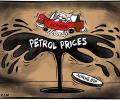
Many states are open to the idea of petrol and diesel being brought under the goods and services tax (GST) regime - contrary to the perception that they are averse to it - but they want a concrete proposal, including a compensation mechanism, from the Centre. West Bengal Finance Minister Amit Mitra says while the issue can be discussed, the Centre may not be keen to bring the change because it earns "much more" from taxes on petrol and diesel. "(The peak rate of) GST is 28 per cent. Under the regime, the Centre would only get 14 per cent. "So, definitely, the Union government does not want GST on fuel. It is all lies. Currently, they are in a very cozy place," Mitra said.

While Union Finance Minister Nirmala Sitharaman reiterated her stand that the central government was committed to cooperative federalism, finance ministers of non-BJP ruled states such as Punjab and Kerala said she refused to give a categorical assurance that states will be paid compensation on time.

The Centre on Thursday placed before the GST Council two options for borrowing by states to meet the shortfall in GST revenues, pegged at Rs 2.35 lakh crore in the current fiscal.

The next meeting of the GST Council on January 16 would discuss the issue of jurisdiction over assessees as well as try to reach a finality on taxation of territorial waters

Several opposition ruled states expressed concern over Centre's decision to allow enforcement directorate (ED) to share information with GST Network, with finance minister of AAP-ruled Punjab Harpal Singh Cheema on Tuesday saying it amounts to 'tax terrorism' and scaring small business. The finance ministry, through a notification, brought in an amendment to the provisions of Prevention of Money Laundering Act (PMLA), 2002, as per which GSTN, which handles the technology backbone of Goods and Services Tax, has been included in the list of entities with which ED will share information. At the 50th GST Council meeting on Tuesday, Aam-Aadmi Party ruled Delhi and Punjab voiced concerns over the notification and demanded a discussion.
The all-powerful GST Council on Friday decided to charge food delivery platforms such as Swiggy and Zomato a tax even as it extended concessional tax rates on certain COVID-19 drugs by three months till December 31. The Council, which comprises the Union finance minister and her state counterparts, decided to continue keeping petrol and diesel out of the GST purview as subsuming the current excise duty and VAT into one national rate would impact revenues. Briefing reporters on the decisions taken by the Council at a meeting here, Union Finance Minister Nirmala Sitharaman said GST has been exempted on muscular atrophy drugs like Zolgensma and Viltepso, which cost crores of rupees.

The GST rate on mobile phones will be hiked to 18 per cent while that on maintenance repair overhaul (MRO) services for aircraft will be lowered to 5 per cent with effect from April 1, Finance Minister Nirmala Sitharaman said on Saturday. The GST rate on handmade and machine-made matchsticks has been rationalised to 12 per cent from 5 per cent and 18 per cent respectively.
If other states follow suit, it is going to become difficult for the GST Council to decide on the next stage of reforms.
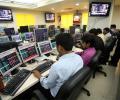
BSE Auto index fell over 0.5% after reports that automobiles might get costlier post GST
Finance ministers from Congress-ruled states say they have alerted the Centre about the problems in GST for several months, but it is only now with the Gujarat assembly election around the corner that the Modi regime has started heeding these suggestions.
The GST Council in its next meeting may look at raising the lowest tax slab to 8 per cent, from 5 per cent, and prune the exemption list in the Goods and Services Tax regime as it looks to increase revenues and do away with states' dependence on Centre for compensation, sources said on Sunday. A panel of state finance ministers is likely to submit its report by this month end to the Council suggesting various steps to raise revenue, including hiking the lowest slab and rationalising the slab. Currently, GST is a four-tier structure attracting a tax rate of 5, 12, 18 and 28 per cent.
'There are unscrupulous traders who create fake invoices by showing bogus e-way bills, movement of goods.' 'Since the entities registered across different states, and kept on changing their numbers, tracing them was difficult.'

The GST Council, that includes representatives of all states, will meet again on November 3-4 to decide on the tax rates
Continued lack of consensus at next meeting could cast shadow on GST rollout by April 1.

Rahul Gandhi, who is scheduled to again visit poll-bound Gujarat from Saturday, said the government can't break the back of small and medium businesses, crush the informal sector and destroy millions of jobs.

'I am doing the drive in making sure that people pass this on. So the drive is not with distrust. The drive is just in case.' 'Just in case it doesn't get passed on, I am here.'
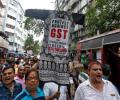
After 17 tumultuous years, a nationwide Goods and Services Tax (GST) will rollout from midnight of June 30, overhauling India's convoluted indirect taxation system and unifying the $2 trillion economy with 1.3 billion people into a single market.

Businesses across the country may soon be required to issue electronic invoices, or e-invoices, directly to consumers for the sale of goods and services. The Goods and Services Tax (GST) Council, in its forthcoming meeting on Monday, is expected to discuss extending the e-invoicing mandate to cover business-to-consumer (B2C) transactions. Currently, e-invoicing is compulsory for businesses with a turnover of Rs 5 crore and above, but only for their business-to-business (B2B) transactions.

GST Council has also reached consensus on the definition of revenue to compensate states for revenue loss

The panel, headed by the Union finance minister and comprising of representatives of all states and UTs, decided on tax rate based on recommendation of a group of ministers that looked at taxing casinos, horse racing and online gaming.
The shortfall in GST compensation payable to states in the current fiscal is estimated at Rs 2.69 lakh crore, of which Rs 1.58 lakh crore would have to be borrowed this year. The Centre expects to collect over Rs 1.11 lakh crore through cess on luxury, demerit and sin goods which will be given to the states to compensate them for the shortfall in revenue arising out of GST implementation. The remaining Rs 1.58 lakh crore would have to be borrowed to meet the promised compensation to states under the Goods and Services Tax (GST) regime.

The question on who should borrow from the market and whether the borrowing will be under two buckets should be decided by the GST Council, and not by the Centre. If there is no consensus, there has to be a vote, says A K Bhattacharya.

Pulse oximeters, hand sanitisers, temperature check equipment and ambulances too will attract lower 5 per cent tax.

The GST Council also decided that a committee of officers will be constituted to examine the simplification of forms for annual return and reconciliation statement.
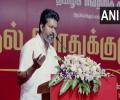
Actor Vijay, founder of the Tamizhaga Vettri Kazhagam (TVK) party, has declared that his party will challenge the ruling DMK in the 2026 Tamil Nadu Assembly elections. In a general council meeting, Vijay criticized the DMK's dynasty politics, their handling of law and order, and women's safety. He also targeted the BJP-led central government over issues like the Waqf Bill, delimitation, and the three-language policy. Vijay promised his party's support to working classes, government employees, and vowed to oppose projects harmful to natural resources and agriculture. He assured 100% safety for women and strict law and order if TVK forms the government. The party passed resolutions opposing the Waqf Bill, delimitation, and the three-language policy, and also voiced support for the two-language policy, finding a permanent solution for fishermen's issues, and opposing the Parandur airport project.

About a dozen states cutting across party lines on Wednesday pitched for extending the mechanism to compensate states for revenue lost from the implementation of GST beyond June 30, but no decision was taken. Briefing reporters about deliberations at the two-day meeting of the GST Council in Chandigarh, Union Finance Minister Nirmala Sitharaman said finance and other ministers of 16 states spoke on the compensation issue. Of the 16 states, 3-4 spoke of evolving their own revenue stream to break from the compensation mechanism, she said.
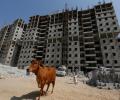
The council also cut GST rates on affordable housing to 1 per cent from the current 8 per cent.
The decision to impose a 28 per cent tax on the full face value of bets placed on online games will be implemented from October 1 even though there was demand for a review from states like Delhi and Goa, finance minister Nirmala Sitharaman said on Wednesday. The GST Council -- the highest decision making body of the new indirect tax regime that comprises Union finance minister and representatives of all states -- discussed the language of amendments that will be needed to enabling taxing online gaming, she said after the panel meeting.

'From the tiniest to mid-level organisations and even some at the lower end of the large-scale ones would say that computerisation and the extensive documentation and regulatory requirements for GST have made the compliance process worse in many cases.'
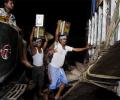
Under GST, the small and medium industries would have to handle things on their own, says V S Krishnan.

http://im.rediff.com/money/2023/jul/20uv.jpg
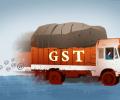
No longer a discretion of the tax administrator, the audit of returns filed by taxpayers is now based on a selection by algorithms, notes Tarun Bajaj.

Dosa batter, custard powder, kitchen lighter may become cheaper under GST
GST council may propose a faster refund procedure, deferment of electronic way bill, further simplification of composition scheme

GST Council decides to extend compensation cess beyond June 2022.

The forthcoming Budget, the last full one before the 2019 Lok Sabha elections, is expected to contain a number of sops and feel-good announcements, especially regarding social sector schemes.

State governments have requested the Centre for export incentives, lifting of import duty in the case of cotton for the textile sector and GST exemptions.
 © 2026 Rediff.com - Advertise with us - Disclaimer - Privacy Policy - Sitemap - Feedback - About us - Terms of use - Grievances